Saturday, 31 March 2018

What is Literature?


What Is Literature ?

Image result for Literature


What is Literature?

As we all known about the Literature  as the X ray image and mirror of society, but here i want to represent the Literature as so many metaphors so here we go to know that what is literature as my point of view........

1)  I am seeing literature as CLOUD:

I am representing the literature as CLOUD just because i think that literature is constantly showering new thoughts and new idea upon us. And through that new plants of thoughts and ideas become grow up inside us.

2) I am seeing literature as ART:

I am representing literature as ART cause i think that literature can paint human’s ideas and thoughts. Its also paint human’s heart so we can say that literature making humans batter.

      “ I Paint flowers so they will not die”

We can see that how deep meaning reflects in this line and this is all because of Literature. So we can say that Literature gives deep meaning of all d things.

3) I am seeing Literature as Moon:

I am representing Literature as a Moon just because Moon does not have his own lights but he can give us lights because of sun so this is  what actually we can see in Literature that Literature does not have that own ideas and thoughts but its reflection of other’s ideas and thoughts.

4)I am seeing Literature as ATHEISM:

You all are may be shocked that how Literature represented as Atheism?, but in Literature books or novel or anything in that we can find that words and dialogues not thinking about anyone or anything its reflects that only that they have reflect. Its not follows any order or anythings.

5)I am seeing Literature as INCENSE STICKS:

Here is another one new metaphor is Incense sticks, I representing Literature as Incense sticks just because its gives fragrance of idea and fragrance of new thoughts. And other thing is that incense sticks are burning itself but then also give or spread fragrances to all humans.

6)I am seeing Literature as  an ARCHEOLOGY:

Here i representing Literature as an Archaeology because in Literature their are so many things that we can seeing as an Archaeology, like we can say that RAMAYANA and MAHABHARAT is an Archaeology of India.

7) I am seeing Literature as an INSPIRATION:

I am representing Literature as an Inspiration, because

“Only in the darkness you can see the stars”
                                                                 -Martin Luther
So here i want to say that if some times we are in trouble or in the darkness of our heart so at that time Literature helps us the most its not gives to us light or that we want but its showing some stars in darkness that can help to us for smile again.

8) I am seeing Literature as BELIEF:

“The more we do to you, The less you seem to believe we are doing it. ”
                                                                                               -Josef Mengele
Here i want to give example of Prayer’s book we all know that all prayer’s books are only our belief  but we are also used to read it because our belief tell to us that believe in this.


9)I am seeing Literature as RIVER:

“The river is one of my favourite metaphors, the symbol of the great flow of life itself. The river begins at Source, and returns to Source, unerringly. This happens every single time , without exception. We are no different.”
                                                                                                                                   -Jeffrey R. Anderson

So This are my view that for me what is Literature. 

Ultimately what i still believe, matches with the idea what I used to think 2 years back. When we entered department, we were asked to write down what do we think , "what is literature.". My view still matches with that. that ultimately its all about pleasure. But what change have taken place is that, it is having more dimensions. 


Thank You.....................................................


Friday, 30 March 2018

The Fakeer Of Jungheera


The Fakeer Of Jungheera By Henry Derozio

Image result for henry derozio

The Fakeer of Jungheer is a long poem by Henry Louis Vivian Derozio. He was born on 18th April, 1809 in Kolkatta, West Bengal. He was a lecturer and poet. He is considered to be an academic and educator During his time Literary Movement of Bengal Renaissance was undergoing. He was an Indian poet and assistant head principal at the Hindu College of kolkatta. He was a radical thinker and one of the first Indian educators to disseminate western Education and science among the young men of Bengal. He died of Cholera at the age of 22.
          Long after his death, his influence lived among his former student, who came to be known as young Bengal and many of whom became prominent in social reform law and journalism. Inspired by the scenic beauty of the river Ganga, he started writing poetry. He was generally considered an Anglo-Indian being of mixed partuguese desent, but he was fired by patriotic spirit for his native Bengal and considered himself Indian.
          He wrote many wonderful poems in English before his untimely death of which. The Fakeer of Jungheera was one of the most important landmark in the history of patriotic poetry in India. As he considered India to be his mother he worried about Indian social, political and religious problem. He also worried about the class and caste discrimination.
          In his days Bengal faced many problems of caste and creed. The reassessment and inclusion of Derozio in the canon of Derozio in the canon of Indian writing in English has to do with many factors, like communism, religious aspects, colonial aspects.
          In 'The Fakeer of Jungheera' Deroiz mixed the tantric, Hindu, Mythological, Islamic and Cristian tradition. He got the idea about writing the poem of spiritual love from Baital Pachisi. As the story goes, if King Vikram remains stead fast  in his love for his queen he can resurrect her and once more both can find happiness together. The dauntless fortitude and courage that The King exemplifies by passing through the horrible ordeals in the graveyard leading to his triumph, inspire conclusion to the tragic death of the Fakeer in the arms of his beloved Nuleeni. If the Nuleeni can again be resurrected in the arms of the Fakeer if she can pass through the horrors and temptations of life.
          Fakeer and Nuleeni are two star crossed lovers like Romeo and Juliet. In Shakespeare's Romeo and Juliet were the children of two enemies whose love brought the tragic end. Here, in 'The Fakeer of Jangheera'.  Fakeer is the follower of Islam. Fakeer means saint a person who has renounced the world but here he loves a lady Nuleeni who is married and also an uppercaste Female. Nuleeni was married to a Brahmin. Her husband dies in an early youth.
          Naleeni, the beloved of Fakeer never loved her husband. In the days of never loved her husband. In the days of Henry Derozio Indian subcontinent was cought by many evils like 'Sati Pratha' killing girl child by boiling the still born baby in the hot pot of milk etc. Nuleeni belonged to a conservative Hindu society in the nineteenth century.  She was pure and beautiful she doesn't went to end her life behind a person whom she never loved.
          Nuleeni was brought to the spot where her husband is to be cremated. Women were singing songs praising sati. They sang of going to heaven but poor Nuleeni was lost in the thoughts of Fakeer. She refuses to die on the funeral pure of her husband and esapes with the bandit faker to his cave in Jungheera to a life from death; She escaped death but she starts a life of forbidden love though frightened by violent social norms she believes that her lover's courage and her anfailing love will finally make them victorious. Her fair and beautiful face brightens the dark social setting of the poem and mitigates the bold audacity of the Fakeer who snatches her from the midst of a group of mourning upper caste Hindu at the Funeral.
          In the intense bond of love they forgot the society. They forgot their caste discrimination. They forget strength of power. They Forgot strength of power. They Challenged the man made norms of the society. Both of them completely forgot themselves and did not realize that their lives were at risk. Fakeer, bravely snatched her from the hands of so called upper-class people. Would they tolerate this insult of taking away of female by weaker sect. Here, the brave rebellion of the weaker sect draws the attention to the inequality of the sexes and social malaise rampant in Bangali Society of the time. In can say that the poem makes an important stage in the use of social themes in literary texts endorsing a syncretistic tradition quite popular in 19th century Bengal. Instead of  be laboring upon the misery of slavery, Derozio embarked upon a mission of resolving some of the inherent evils of Hindu society especially the practice of widow burning.
          The romantic atmosphere is raise due to the development of Hindu-Muslim love affair. The Fakeer of Jungheera is in two cantos of twenty eight and twenty four stanzas respectively written in the iambic, anapestic, trochaic and dactylic meters to suit the different rhythems ranging from the normal spoken voice and slow description to the racy battles and the chant of priests and women.
          The poem starts with nature's description and then takes many twists. The poem deals with many serious issues of social evil along with the tragic love affir as the protagonist of the poem is a robber Fakeer who belongs to some unidentified Muslim sect, While the heroine, the widow Nuleeni, comes from an upper caste Bengali Hindu family. Derozio uses Cristain Imagery, Such as heaven and angles flitting about. He juxtaposes this imagery against the Hindu tradition of sati and muslim prayers. He imitates the English Romantic poets like wordsworth, shelly and Coleridge. In the poem, the imagination is marvelous.
          Derozio breaks all the norms of writing of the contemporary poem writing. It was not easy for the contemporary writers to break the established laws and at the same time challenging the upper-class of the cosecant. He wanted to eradicate the social evils that slowly swallowed the society. This Hindu-Muslim love story arose great sensation. The poet was marginalized in his time.
          The poet paints the heroine as a 'perfect' Bengali beauty – with large black eyes, black in braided tresses, a pale lily complexion and majestic walk. When she arrives at the funeral her eyes searched somebody when he comes she escapes with. He, her lover Fakery had to fight before taking his beloved with him. At the Fakeer's cave. Nuleeni and he lived very happily. They both are lost in the materialistic. They both are lost in the materialistic imaginative life. They are lost in their world. But Nuleeni in the midst of happy life always feared of some unseen danger. Here, the midst of happy life always feared of some unseen danger. Here, the description of nature seems to be one with the feeling of the love.
          The first canto of the poem mainly deals with the fantastic description of nature, the funeral procession of a Bengali upper-class Hindu family's son, the escape of the widow with her faker lover to his cave. The upper-class widow lived with many maid lives happily in the cave of her Fakeer lover always waiting for something unseen to harm them. She smelt something wrong. She worried for she doesn't want to depart from her lover at any cost. Many a times through the poetry we see her lost in her world, sometime. We see Fakeer lost in his dreamland.
          As happens in ancient Greek tragedies and Shakespearean tragedies, their tragic doom and mistake of risking their life were waiting for them. As they were run-away lovers Nuleeni's father – the so called upper-class widow's father would definitely revenge him.
          Now, Derozio sees love between a Hindu and a Muslim as transcending religion, though this could be Derozio's own atheistic vision of religion categories based on his rationalistic temper. There was a hardening of identity of Bengali Muslims in the subcontinent as Islam provided 'a sense of belonging' to the Muslim community. In the absence of powerful Muslim leadership in 19th century Bengal, the ulema emerged as the leaders. Britishers were partial too. On one hand the prohibited sati system on the other hand they allowed being sati with permission. The hardening of religious categories in colonial Bengali lays the ground for the inevitable conflict that ensues in the second canto.
          In the beginning of the canto the end lies. The popular belief that love for a woman can lead any god-fearing young man away from the worship of Allah. Then starts the tragic events one by one. The father of beautiful widow Nuleeni determines to avenge Fakeer. He goes to Shah Shiva the king of his time. He requests him to send  his army with him to avenge the Fakeer. The uncertainty of life and death begins at this stage. Nuleeni's father comes to the place where the lovers lived with the army to avenge his insult. He did not even think of his daughter's happiness or love.
          Now Fakeer has no choice, if he runs away from the battle field. He would be caught and punished. He decides to fight back the army of Nuleeni's father. The story at this point becomes somewhat sketchy but the robber Fakeer decides to make a lost stand and  fight. However Nuleeni fears that the dubious hour might bring doom :
          Let me warn the that our doom so bright may darkly end – as darkly speeds the night – But the Fakeer is confident of Victory.
          Ere long I'll worn thee in my breast again –
          With the 'battle cry' of 'the moslem ringing afar' to fight the 'royal cavalry', he is mortally wounded with a lance.
          Nulleeni cradles him in her arms and dies together with him – he 'eloquence had all burned out'. She becomes a free agent to choose her destiny; she prefers to die together with someone she loves than with her husband whom she does not. In ancient India woman were allowed to choose their life partners on their own. In our Epics sita, Rukmani, Sati, Parvati (The incarmation of Sati) Draupadi, Subhadra, Kunti, Gandhari, Sanyogita etc. Choose their husband on their own. In absence of Pritiviraj Chauhan Sanyogita put  garland on his statue and took her with him – such was grand and glorious past culture of India which was ruined due to foreign invasion.
          Nuleeni did not die behind her husband. Now, she is free here to die with Fakeer. She did not die with her husband because she did not love him but she loved Fakeer beyond anything else in the world. For him she left all the luxuries of her life, He also risked his life to be united but they were doomed to depart. Nuleeni decides to die behind him. The Sanskrit word sati means a 'good and vitreous woman' who was truly devoted to her husband. And according to the Hindu tradition these virtues found expression is the ultimate act of self-immdation. Women who sacrificed themselves continued to be called sati long after they were dead and usage of the term 'to the sacrifice alone, the act as well as the agent.
          The secular and universal ideas that Derozio espoused in his poetry do not go well with the separatist and divisionary politics of modern India.  These are some of the revisionist consequences of modernity. However, the 'modes of social life' that emerged in the early nineteenth century in response to modernity in India now take us 'beyond modernity' into the information age. If India must shine it must do so within its own traditions and Derozio occupies a central place in it. The poet through the impossible and bold story of love – affair between Hindu upper-class widow and a Muslim lower class Fakeer reflected and criticized the evils of Indian Society.

Frankenstein By Mary Shelley

Frankenstein By Mary Shelley

Image result for frankenstein summary by mary shelley


In a series of letters, Robert Walton, the captain of a ship bound for the North Pole, recounts to his sister back in England the progress of his dangerous mission. Successful early on, the mission is soon interrupted by seas full of impassable ice. Trapped, Walton encounters Victor Frankenstein, who has been traveling by dog-drawn sledge across the ice and is weakened by the cold. Walton takes him aboard ship, helps nurse him back to health, and hears the fantastic tale of the monster that Frankenstein created.

Victor first describes his early life in Geneva. At the end of a blissful childhood spent in the company of Elizabeth Lavenza (his cousin in the 1818 edition, his adopted sister in the 1831 edition) and friend Henry Clerval, Victor enters the university of Ingolstadt to study natural philosophy and chemistry. There, he is consumed by the desire to discover the secret of life and, after several years of research, becomes convinced that he has found it.

Armed with the knowledge he has long been seeking, Victor spends months feverishly fashioning a creature out of old body parts. One climactic night, in the secrecy of his apartment, he brings his creation to life. When he looks at the monstrosity that he has created, however, the sight horrifies him. After a fitful night of sleep, interrupted by the specter of the monster looming over him, he runs into the streets, eventually wandering in remorse. Victor runs into Henry, who has come to study at the university, and he takes his friend back to his apartment. Though the monster is gone, Victor falls into a feverish illness.
Sickened by his horrific deed, Victor prepares to return to Geneva, to his family, and to health. Just before departing Ingolstadt, however, he receives a letter from his father informing him that his youngest brother, William, has been murdered. Grief-stricken, Victor hurries home. While passing through the woods where William was strangled, he catches sight of the monster and becomes convinced that the monster is his brother’s murderer. Arriving in Geneva, Victor finds that Justine Moritz, a kind, gentle girl who had been adopted by the Frankenstein household, has been accused. She is tried, condemned, and executed, despite her assertions of innocence. Victor grows despondent, guilty with the knowledge that the monster he has created bears responsibility for the death of two innocent loved ones.
Hoping to ease his grief, Victor takes a vacation to the mountains. While he is alone one day, crossing an enormous glacier, the monster approaches him. The monster admits to the murder of William but begs for understanding. Lonely, shunned, and forlorn, he says that he struck out at William in a desperate attempt to injure Victor, his cruel creator. The monster begs Victor to create a mate for him, a monster equally grotesque to serve as his sole companion.
Victor refuses at first, horrified by the prospect of creating a second monster. The monster is eloquent and persuasive, however, and he eventually convinces Victor. After returning to Geneva, Victor heads for England, accompanied by Henry, to gather information for the creation of a female monster. Leaving Henry in Scotland, he secludes himself on a desolate island in the Orkneys and works reluctantly at repeating his first success. One night, struck by doubts about the morality of his actions, Victor glances out the window to see the monster glaring in at him with a frightening grin. Horrified by the possible consequences of his work, Victor destroys his new creation. The monster, enraged, vows revenge, swearing that he will be with Victor on Victor’s wedding night.
Later that night, Victor takes a boat out onto a lake and dumps the remains of the second creature in the water. The wind picks up and prevents him from returning to the island. In the morning, he finds himself ashore near an unknown town. Upon landing, he is arrested and informed that he will be tried for a murder discovered the previous night. Victor denies any knowledge of the murder, but when shown the body, he is shocked to behold his friend Henry Clerval, with the mark of the monster’s fingers on his neck. Victor falls ill, raving and feverish, and is kept in prison until his recovery, after which he is acquitted of the crime.
Shortly after returning to Geneva with his father, Victor marries Elizabeth. He fears the monster’s warning and suspects that he will be murdered on his wedding night. To be cautious, he sends Elizabeth away to wait for him. While he awaits the monster, he hears Elizabeth scream and realizes that the monster had been hinting at killing his new bride, not himself. Victor returns home to his father, who dies of grief a short time later. Victor vows to devote the rest of his life to finding the monster and exacting his revenge, and he soon departs to begin his quest.
Victor tracks the monster ever northward into the ice. In a dogsled chase, Victor almost catches up with the monster, but the sea beneath them swells and the ice breaks, leaving an unbridgeable gap between them. At this point, Walton encounters Victor, and the narrative catches up to the time of Walton’s fourth letter to his sister.
Walton tells the remainder of the story in another series of letters to his sister. Victor, already ill when the two men meet, worsens and dies shortly thereafter. When Walton returns, several days later, to the room in which the body lies, he is startled to see the monster weeping over Victor. The monster tells Walton of his immense solitude, suffering, hatred, and remorse. He asserts that now that his creator has died, he too can end his suffering. The monster then departs for the northernmost ice to die.

Paradise Lost

Paradise Lost By John Milton

Image result for paradise lost summary


Paradise Lost opens with Satan on the surface of a boiling lake of lava in Hell (ouch!); he has just fallen from Heaven, and wakes up to find himself in a seriously horrible place. He finds his first lieutenant (his right-hand man), and together they get off the lava lake and go to a nearby plain, where they rally the fallen angels. They have a meeting and decide to destroy Adam and Eve (God's children and precious science experiment) in order to spite God. Satan volunteers for the job and leaves Hell to go look for Adam and Eve.

The scene then shifts to Heaven (Book 3), where God talks about how he can see what Satan is planning. He knows everything all the time. He has a conversation with His Son, says he knows that Satan will tempt mankind and that Adam and Eve will eat the fruit of the Forbidden Tree. He needs to know if anyone will intervene on man's behalf. The Son volunteers, which makes God and all the angels in Heaven very happy.

The scene shifts again, this time to Eden. Satan has reached the Garden, and we see Eden and Adam and Eve for the first time through his eyes. We watch Adam and Eve hang out together for a while, before going into their hut to go to bed and make love. Meanwhile, God has sent out a search party to get Satan out of the Garden, which is easy as pie. The next day, God sends the angel Raphael to talk to Adam and Eve about Satan and whatever else they might want to know. About a week after Adam's chat with Raphael, Satan returns to the Garden, disguises himself as a serpent (snake), and convinces Eve to eat the Forbidden Fruit. She in turn convinces Adam to have a taste. After that, they have steamy, lustful sex for the first time.

As a result of Adam and Eve's sin (eating the Forbidden Fruit), the gates of Hell are now wide open for Sin and Death (who are actual characters in this poem) to build a bridge from Hell to earth. Satan returns to Hell triumphant, but he and his angels are eventually turned into serpents as punishment for Satan's evil deed. 

As for Adam and Eve's punishment, God makes them leave the Garden of Eden. He also introduces death, labor pains, and a bunch of other not-so-fun stuff into the world. Before they leave Paradise, however, God sends the angel Michael down to give Adam a vision of the future. After his history lesson, Adam and Eve leave the Garden of Eden in what is one of the saddest moments in English literature.

Sense and Sensibility

Sense and Sensibility By Jane Austen

Image result for sense and sensibility summary


This is the story of Elinor and Marianne Dashwood, sisters who respectively represent the "sense" and "sensibility" of the title. With their mother, their sister Margaret, and their stepbrother John, they make up the Dashwood family.
Henry Dashwood, their father, has just died. Norland Park, his estate, is inherited by John; to his chagrin, Henry has nothing but ten thousand pounds to leave to his wife and daughters. On his deathbed, he urges John to provide for them and John promises that he will do so. He is already wealthy because he has a fortune from his mother and is also married to the wealthy Fanny Ferrars.
Immediately after Henry's burial, the insensitive Mrs. Dashwood moves into Norland Park and cleverly persuades John not to make any provision for his stepmother and stepsisters. Mrs. Henry Dashwood, disliking Fanny, wants to leave Norland Park at once, but Elinor prudently restrains her until they can find a house within their means.
Edward Ferrars, Fanny's brother, comes to stay and is attracted to Elinor. Mrs. Dashwood and Marianne expect an engagement, but Elinor is not so sure; she knows that Mrs. Ferrars and Fanny will object to Edward's interest in her. Fanny takes exception to Edward's fondness for Elinor and is so rude that Mrs. Dashwood at once rents a cottage fortuitously offered to her by her cousin, Sir John Middleton.
The Dashwoods move to Barton Cottage and are met by Sir John, who does all in his power to make them comfortable. They soon meet his elegant but insipid wife and their four children.
One day, when Marianne and Margaret are walking on the downs, Marianne sprains her ankle. She is carried home by a stranger, John Willoughby, who is staying at Allenham Court, a country estate which he will inherit after the death of its elderly owner, Mrs. Smith. Marianne and Willoughby fall in love and are inseparable. But after a short time, Willoughby leaves unexpectedly for London without explaining or declaring himself.
Edward Ferrars soon pays a visit to Barton Cottage. But he is distraught and gloomy, and Elinor is puzzled by his reserve.
Lady Middleton's mother, Mrs. Jennings, has been staying at Barton Park. She teases Marianne about Colonel Brandon, a friend of Sir Henry, who obviously admires Marianne. Though she likes the colonel, Mrs. Jennings repeats some scandal about him; he is said to have an illegitimate daughter, Miss Williams.
Lady Middleton's younger sister, Charlotte Palmer, and her husband visit Barton Park. When they leave, Sir John invites the Misses Steele, two young ladies whom he has met in Exeter and has found to be connections of Mrs. Jennings.
Lucy confides to Elinor that she has been secretly engaged to Edward Ferrars for four years. He was tutored by her uncle and became well acquainted with Lucy and Anne at that time. Elinor is shocked but concludes that Edward had a youthful infatuation for Lucy. Lucy persists in asking for advice and begs Elinor to persuade her brother John to give Edward the Barton living if he decides to take orders.
Mrs. Jennings invites Elinor and Marianne to stay with her in London. Marianne is eager to go because she hopes to see Willoughby there. He has not been back to visit them, nor has he written to Marianne.
In London, Marianne waits for a visit from Willoughby. She writes him several times but receives no reply. One day he leaves his card but never calls personally.
Finally, Elinor and Marianne see Willoughby at a dance with a fashionable heiress, Miss Grey. He speaks curtly to Marianne, who is distracted by his coldness. She writes him for an explanation, and he returns her letters with a cruel note, denying that he had ever been especially interested in her and announcing his engagement to Miss Grey.
Colonel Brandon, who is also in London, is distressed by Willoughby's conduct to Marianne and tells Elinor his own story. As a young man, he had loved his cousin Eliza, his father's ward. But to gain Eliza's fortune, his father had married her to his eldest son, who had treated her badly. Years later, the colonel discovered that Eliza had left her husband for another man. She had sunk lower and lower, and was now penniless and on her deathbed. The colonel did all he could for her and promised to bring up her daughter, also named Eliza. Eliza, now grown, had been seduced by Willoughby, who had deserted her. The colonel had fought a duel with Willoughby, but neither had been injured.
John Dashwood and his wife come to London for the season. He meets his sisters and is introduced to the Middletons, whom he finds very congenial. Anne and Lucy Steele are invited to stay with the Middletons and eventually pay a visit to the Dashwoods, John and Fanny. They are treated so kindly that Anne feels it is safe to break the secret of Lucy's engagement to Edward.
Fanny Dashwood has hysterics and orders Lucy and Anne out of her house. Edward's mother disinherits him because he will not break his word to Lucy. He decides to take orders and offers to free Lucy from her engagement, but Lucy will not give him up.
Charlotte Palmer's son is born, and she invites Elinor and Marianne to accompany her mother on a visit to her country house, Cleveland. Marianne falls ill there and seems near death. Colonel Brandon is also staying at Cleveland and offers to fetch Mrs. Dashwood.
The Palmers leave their house, fearing infection for the baby, and while Elinor awaits her mother's arrival, she is amazed by a visit from Willoughby. He has heard of Marianne's illness and has come to get news of her. He tells Elinor how bitterly he repents of his conduct and how wretched his wife has made him; it was she who dictated the cruel note which he sent to Marianne. Elinor is sorry for him.
Marianne recovers and the family returns to Barton Cottage. Eventually, Elinor tells Marianne about Willoughby's repentant visit. Marianne is now sorry that the family has suffered on her behalf.
One day, a servant tells them that Edward Ferrars is married. Elinor tries to put him out of her mind; however, he arrives at Barton Cottage and explains that Lucy did not marry him; instead, she eloped with his brother, Robert.
Everything ends happily. Edward is reconciled to his mother and marries Elinor. He takes orders and is given the living at Delaford, Colonel Brandon's estate. Eventually Marianne agrees to marry the colonel, and the two couples live happily, close in distance and in friendship.

Tom Jones


Tom Jones By Henry Fielding

Image result for tom jones summary


The narrator provides that his purpose in the text will be to explore "human nature." As such, his story veers between several extremes - comedy and tragedy, low and high society, moral and base.
Squire Allworthy, a man defined by his interminable kindness, returns to his Somersetshire estate to find a child abandoned in his bed. He gives the child to his sister Bridget to look after, and they investigate to determine that the child's mother is a young woman named Jenny Jones. She leaves the area, and Allworthy decides to raise the boy, Tom Jones. Tom is brought up alongside Allworthy’s nephew Blifil, Bridget's son. They are educated by two men of differing outlook, Thwackum and Square. Blifil is a miserable and jealous boy.
Tom is an impetuous character who supports his friend, the poor gamekeeper Black George Seagrim, even when that support causes him trouble. Meanwhile, through his relationship with Squire , Allworthy's boorish but affable neighbor, Tom slowly falls in love with the squire's daughter Sophie, who also comes to love him.
However, Tom cannot pursue Sophia because his girlfriend Molly, daughter to Black George, grows pregnant with what he believes to be his son. When he is revealed not to be the father of Molly’s child, Tom is free to pursue his emerging love for Sophia.
Blifil conspires against Tom, and he is unjustly turned out of Allworthy’s house and away from Sophia. Further, because Tom is a bastard child, Squire Western refuses to support Tom's suit for Sophia, and instead wishes her to marry Blifil so that he can consolidate their lands. Sophia hates Blifil, and is tortured by her father's cruel insistence.
Allworthy gives Tom a fair sum of money to support himself, but it is stolen by Black George. Tom considers joining the military. He meets up with , a teacher-cum-barber whose reputation was ruined when he was believed to be Tom’s father years before. Partridge initially believes that he can return to Allworthy’s favor if he reunites the man with Tom, but Partridge ultimately becomes a devoted companion along the way. Tom frequently shows his benevolent spirit by helping an unsuccessful highwayman, a beggar and a lady in distress - all gestures which are richly repaid later in the novel.
Sophia is locked up for refusing to marry Blifil. She flees, and both Tom and Sophia try to locate each other on their respective journeys to London. She discovers he has slept with Mrs. Waters (a woman he rescues) and that he is mentioning her name to strangers, and she decides he must not love her. She then heads to London, and Tom follows her.
While in London, Tom takes up with the promiscuous and wily Lady Bellaston,with whom Sophia is staying. She promises to help him but endeavors to keep the lovers apart.
Sophia is also roughly courted by Lord Fellamu Her aunt, Lady Western, is anxious for her to marry him, whereas her father is still adamant that she will marry Blifil. Sophia decides she will marry no-one without her father’s consent, but will also not be told whom to marry.
Tom is innocently caught up in a duel and imprisoned. His friend Nightingale loyal companion Partridge, and devoted landlady Mrs.Miller investigate the course of Tom’s imprisonment and sustain his contact with Sophia. There is tension when it is initially believed that Mrs. Waters is Tom’s mother, but this is revealed to be untrue. Allworthy is shocked to discover that Tom is his nephew, Bridget’s illegitimate but first-born son, and that Blifil has known about this since his mother’s death. It is discovered that Blifil engineered Tom's imprisonment to get him out of the way.
The charges against Tom are dropped and his marriage to Sophia is blessed by both Allworthy and Squire Western. Blifil is banished but has an annuity from Allworthy and Tom. Sophia and Tom live happily, close to Nightingale and Mrs. Miller’s daughter Nancy, whose union Tom facilitated. Partridge is given an annuity to start a new school and marries Tom’s first girl, Molly Seagrim.

Robinson Crusoe

Robinson Crusoe By Deniel Defoe


Related image


Robinson Crusoe, as a young and impulsive wanderer, defied his parents and went to sea. He was involved in a series of violent storms at sea and was warned by the captain that he should not be a seafaring man. Ashamed to go home, Crusoe boarded another ship and returned from a successful trip to Africa. Taking off again, Crusoe met with bad luck and was taken prisoner in Sallee. His captors sent Crusoe out to fish, and he used this to his advantage and escaped, along with a slave.

He was rescued by a Portuguese ship and started a new adventure. He landed in Brazil, and, after some time, he became the owner of a sugar plantation. Hoping to increase his wealth by buying slaves, he aligned himself with other planters and undertook a trip to Africa in order to bring back a shipload of slaves. After surviving a storm, Crusoe and the others were shipwrecked. He was thrown upon shore only to discover that he was the sole survivor of the wreck.
Crusoe made immediate plans for food, and then shelter, to protect himself from wild animals. He brought as many things as possible from the wrecked ship, things that would be useful later to him. In addition, he began to develop talents that he had never used in order to provide himself with necessities. Cut off from the company of men, he began to communicate with God, thus beginning the first part of his religious conversion. To keep his sanity and to entertain himself, he began a journal. In the journal, he recorded every task that he performed each day since he had been marooned.
As time passed, Crusoe became a skilled craftsman, able to construct many useful things, and thus furnished himself with diverse comforts. He also learned about farming, as a result of some seeds which he brought with him. An illness prompted some prophetic dreams, and Crusoe began to reappraise his duty to God. Crusoe explored his island and discovered another part of the island much richer and more fertile, and he built a summer home there.
One of the first tasks he undertook was to build himself a canoe in case an escape became possible, but the canoe was too heavy to get to the water. He then constructed a small boat and journeyed around the island. Crusoe reflected on his earlier, wicked life, disobeying his parents, and wondered if it might be related to his isolation on this island.
After spending about fifteen years on the island, Crusoe found a man's naked footprint, and he was sorely beset by apprehensions, which kept him awake many nights. He considered many possibilities to account for the footprint and he began to take extra precautions against a possible intruder. Sometime later, Crusoe was horrified to find human bones scattered about the shore, evidently the remains of a savage feast. He was plagued again with new fears. He explored the nature of cannibalism and debated his right to interfere with the customs of another race.
Crusoe was cautious for several years, but encountered nothing more to alarm him. He found a cave, which he used as a storage room, and in December of the same year, he spied cannibals sitting around a campfire. He did not see them again for quite some time.
Later, Crusoe saw a ship in distress, but everyone was already drowned on the ship and Crusoe remained companionless. However, he was able to take many provisions from this newly wrecked ship. Sometime later, cannibals landed on the island and a victim escaped. Crusoe saved his life, named him Friday, and taught him English. Friday soon became Crusoe's humble and devoted slave.
Crusoe and Friday made plans to leave the island and, accordingly, they built another boat. Crusoe also undertook Friday's religious education, converting the savage into a Protestant. Their voyage was postponed due to the return of the savages. This time it was necessary to attack the cannibals in order to save two prisoners since one was a white man. The white man was a Spaniard and the other was Friday's father. Later the four of them planned a voyage to the mainland to rescue sixteen compatriots of the Spaniard. First, however, they built up their food supply to assure enough food for the extra people. Crusoe and Friday agreed to wait on the island while the Spaniard and Friday's father brought back the other men.
A week later, they spied a ship but they quickly learned that there had been a mutiny on board. By devious means, Crusoe and Friday rescued the captain and two other men, and after much scheming, regained control of the ship. The grateful captain gave Crusoe many gifts and took him and Friday back to England. Some of the rebel crewmen were left marooned on the island.
Crusoe returned to England and found that in his absence he had become a wealthy man. After going to Lisbon to handle some of his affairs, Crusoe began an overland journey back to England. Crusoe and his company encountered many hardships in crossing the mountains, but they finally arrived safely in England. Crusoe sold his plantation in Brazil for a good price, married, and had three children. Finally, however, he was persuaded to go on yet another voyage, and he visited his old island, where there were promises of new adventures to be found in a later account.

Gulliver's Travels

Gulliver's Travels By Jonathan Swift

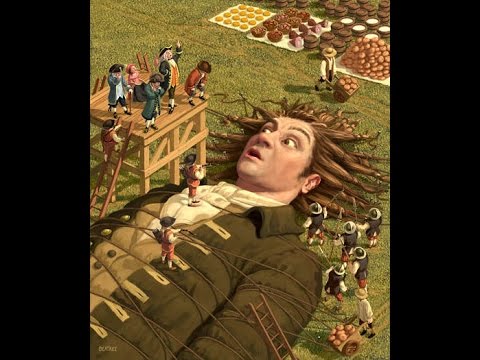
Related image


Gulliver goes on four separate voyages in Gulliver's Travels. Each journey is preceded by a storm. All four voyages bring new perspectives to Gulliver's life and new opportunities for satirizing the ways of England.
The first voyage is to Lilliput, where Gulliver is huge and the Lilliputians are small. At first the Lilliputians seem amiable, but the reader soon sees them for the ridiculous and petty creatures they are. Gulliver is convicted of treason for "making water" in the capital (even though he was putting out a fire and saving countless lives)--among other "crimes."
The second voyage is to Brobdingnag, a land of Giants where Gulliver seems as small as the Lilliputians were to him. Gulliver is afraid, but his keepers are surprisingly gentle. He is humiliated by the King when he is made to see the difference between how England is and how it ought to be. Gulliver realizes how revolting he must have seemed to the Lilliputians.
Gulliver's third voyage is to Laputa (and neighboring Luggnagg and Glubdugdribb). In a visit to the island of Glubdugdribb, Gulliver is able to call up the dead and discovers the deceptions of history. In Laputa, the people are over-thinkers and are ridiculous in other ways. Also, he meets the Stuldbrugs, a race endowed with immortality. Gulliver discovers that they are miserable.
His fourth voyage is to the land of the Houyhnhnms, who are horses endowed with reason. Their rational, clean, and simple society is contrasted with the filthiness and brutality of the Yahoos, beasts in human shape. Gulliver reluctantly comes to recognize their human vices. Gulliver stays with the Houyhnhnms for several years, becoming completely enamored with them to the point that he never wants to leave. When he is told that the time has come for him to leave the island, Gulliver faints from grief. Upon returning to England, Gulliver feels disgusted about other humans, including his own family.

Hamlet

 Hemlet By William Shakespeare


Image result for hamlet shakespeare
Prince Hamlet is depressed. Having been summoned home to Denmark from school in Germany to attend his father's funeral, he is shocked to find his mother Gertude already remarried. The Queen has wed Hamlet's Uncle Claudius, the dead king's brother. To Hamlet, the marriage is "foul incest." Worse still, Claudius has had himself crowned King despite the fact that Hamlet was his father's heir to the throne. Hamlet suspects foul play.
When his father's ghost visits the castle, Hamlet's suspicions are confirmed. The Ghost complains that he is unable to rest in peace because he was murdered. Claudius, says the Ghost, poured poison in King Hamlet's ear while the old king napped. Unable to confess and find salvation, King Hamlet is now consigned, for a time, to spend his days in Purgatory and walk the earth by night. He entreats Hamlet to avenge his death, but to spare Gertrude, to let Heaven decide her fate.
Hamlet vows to affect madness — puts "an antic disposition on" — to wear a mask that will enable him to observe the interactions in the castle, but finds himself more confused than ever. In his persistent confusion, he questions the Ghost's trustworthiness. What if the Ghost is not a true spirit, but rather an agent of the devil sent to tempt him? What if killing Claudius results in Hamlet's having to relive his memories for all eternity? Hamlet agonizes over what he perceives as his cowardice because he cannot stop himself from thinking. Words immobilize Hamlet, but the world he lives in prizes action.
In order to test the Ghost's sincerity, Hamlet enlists the help of a troupe of players who perform a play called The Murder of Gonzagoto which Hamlet has added scenes that recreate the murder the Ghost described. Hamlet calls the revised play The Mousetrap, and the ploy proves a success. As Hamlet had hoped, Claudius' reaction to the staged murder reveals the King to be conscience-stricken. Claudius leaves the room because he cannot breathe, and his vision is dimmed for want of light. Convinced now that Claudius is a villain, Hamlet resolves to kill him. But, as Hamlet observes, "conscience doth make cowards of us all."
In his continued reluctance to dispatch Claudius, Hamlet actually causes six ancillary deaths. The first death belongs to Polonius, whom Hamlet stabs through a wallhanging as the old man spies on Hamlet and Gertrude in the Queen's private chamber. Claudius punishes Hamlet for Polonius' death by exiling him to England. He has brought Hamlet's school chums Rosencrantz and Guildenstern to Denmark from Germany to spy on his nephew, and now he instructs them to deliver Hamlet into the English king's hands for execution. Hamlet discovers the plot and arranges for the hanging of Rosencrantz and Guildenstern instead. Ophelio, distraught over her father's death and Hamlet's behavior, drowns while singing sad love songs bemoaning the fate of a spurned lover. Her brother, Laertes, falls next.
Laertes, returned to Denmark from France to avenge his father's death, witnesses Ophelia's descent into madness. After her funeral, where he and Hamlet come to blows over which of them loved Ophelia best, Laertes vows to punish Hamlet for her death as well.
Unencumbered by words, Laertes plots with Claudius to kill Hamlet. In the midst of the sword fight, however, Laertes drops his poisoned sword. Hamlet retrieves the sword and cuts Laertes. The lethal poison kills Laertes. Before he dies, Laertes tells Hamlet that because Hamlet has already been cut with the same sword, he too will shortly die. Horatio diverts Hamlet's attention from Laertes for a moment by pointing out that "The Queen falls."
Gertrude, believing that Hamlet's hitting Laertes means her son is winning the fencing match, has drunk a toast to her son from the poisoned cup Claudius had intended for Hamlet. The Queen dies.
As Laertes lies dying, he confesses to Hamlet his part in the plot and explains that Gertrude's death lies on Claudius' head. Finally enraged, Hamlet stabs Claudius with the poisoned sword and then pours the last of the poisoned wine down the King's throat. Before he dies, Hamlet declares that the throne should now pass to Prince Fortinbras of Norway, and he implores his true friend Horatio to accurately explain the events that have led to the bloodbath at Elsinore. With his last breath, he releases himself from the prison of his words: "The rest is silence."
The play ends as Prince Fortinbras, in his first act as King of Denmark, orders a funeral with full military honors for slain Prince Hamlet.